Transgenerational Epigenetic Inheritance

Here is a question that Micko wonders about but is not smart enough to answer, but maybe some of you smart clowns can have a discussion about:
     Is it possible that part of the process of creating a World of Love will involve Love Flow being       passed on to future generations via gene expression?

The ideas expressed on this site involve a form of transgeneral shifting involving learning and teaching. Parents teach young clowns how to ride a bike, and the young clowns learn how to ride a bike. Those young clowns can later on in life teach their young clowns to ride a bike. Over time clowns invent more complicated bikes, which can then be learned and taught. This can go on for generations.

The same is true for learning Lovesight. Lovesight can be learned and taught and this process can go on for generations.

The notion that learning can be passed on to future generations is called “transgenerational  inheritance” and has to do with gene expression.

Micko has read about this but does not understand it. It involves learning and maybe teaching, but the mechanism is different…”gene expression” passed on to future generations.


https://lifestyle.sustainability-directory.com/term/transgenerational-inheritance/#:~:text=Implications%20for%20Human%20Health,the%20health%20of%20our%20descendants. 

 inheritance of acquired traits. In mammals, the evidence is more limited and often confounded by the complexities of separating epigenetic effects from genetic, cultural, and environmental factors

A major obstacle to transgenerational epigenetic inheritance in mammals is the extensive reprogramming of the epigenome that occurs in the germline and early embryo. This process erases the vast majority of epigenetic marks, effectively resetting the epigenetic landscape for the next generation. However, some loci, known as “escapees,” have been shown to resist this reprogramming, allowing for the potential transmission of epigenetic information across generations. The mechanisms that protect these loci from erasure are not yet fully understood, but they are thought to involve specific DNA sequences, chromatin structures, and RNA molecules.

By providing a potential mechanism for the inheritance of acquired characteristics, transgenerational epigenetic inheritance challenges the central dogma of molecular biology and offers a new perspective on the interplay between genes and the environment.
The field of transgenerational epigenetic inheritance is still in its infancy, and many questions remain to be answered. Future research will need to focus on identifying the specific epigenetic marks that are transmitted across generations, understanding the mechanisms that allow them to escape reprogramming, and determining their functional consequences for the health and development of offspring. One of the biggest challenges will be to design studies that can effectively disentangle the effects of epigenetic inheritance from other forms of inheritance, particularly in humans. Despite these challenges, the study of transgenerational epigenetic inheritance holds great promise for advancing our understanding of heredity, evolution, and the developmental origins of health and disease.
https://learn.genetics.utah.edu/content/epigenetics/inheritance/

We used to think that a new embryo’s epigenome was completely erased and rebuilt from scratch. But this isn’t completely true. Some epigenetic tags remain in place as genetic information passes from generation to generation, a process called epigenetic inheritance.

Epigenetic inheritance is an unconventional finding. It goes against the idea that inheritance happens only through the DNA code that passes from parent to offspring. It means that a parent’s experiences, in the form of epigenetic tags, can be passed down to future generations.

As unconventional as it may be, there is little doubt that epigenetic inheritance is real. In fact, it explains some strange patterns of inheritance geneticists have been puzzling over for decades.
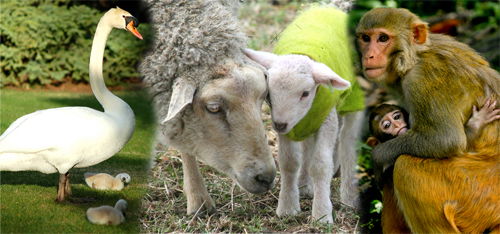
Baby Animals

Overcoming the Reprogramming Barrier

Most complex organisms develop from specialized reproductive cells (eggs and sperm in animals). Two reproductive cells meet, then they grow and divide to form every type of cell in the adult organism. In order for this process to occur, the epigenome must be erased through a process called “reprogramming.”

Reprogramming is important because eggs and sperm develop from specialized cells with stable gene expression profiles. In other words, their genetic information is marked with epigenetic tags. Before the new organism can grow into a healthy embryo, the epigenetic tags must be erased.

pigenetic inheritance adds another dimension to the modern picture of evolution. The genome changes slowly, through the processes of random mutation and natural selection. It takes many generations for a genetic trait to become common in a population. The epigenome, on the other hand, can change rapidly in response to signals from the environment. And epigenetic changes can happen in many individuals at once. Through epigenetic inheritance, some of the experiences of the parents may pass to future generations. At the same time, the epigenome remains flexible as environmental conditions continue to change. Epigenetic inheritance may allow an organism to continually adjust its gene expression to fit its environment – without changing its DNA code.
Three generations at once are exposed to the same environmental conditions (diet, toxins, hormones, etc.). In order to provide a convincing case for epigenetic inheritance, an epigenetic change must be observed in the 4th generation.
Micko wonders if at some point clowns’ Love Flow could become genetic. A World of Love could actually be inherent in our genes.
What do you think?


Shares
0
Would love your thoughts, please comment.x
()
x